For most of Dreadmark's life every weapon swung like a one-handed sword, because under the hood every weapon was a one-handed sword with a different mesh. Over this stretch the arsenal grew a body, with weapons in both hands and the bow on the back.
A one-handed swing plays on the upper body only, so you can slash while running, and that fast, mobile style is the baseline the combat was tuned around. A greatsword is a whole-body motion. Play it on the torso over running legs and it looks like two characters stapled together. So two-handers now plant and swing. The full body commits to the strike, the feet step with it, and for that half-second you are rooted. In exchange the blade reaches further and hits like a verdict, and it has its own deliberate walking and running carriage instead of a sped-up one-hander's. Reach became a stat in its own right. Every base carries an authored reach in metres, seeded by measuring every weapon mesh in the game from the hilt to its farthest point. The swing's hit zone, the aim preview, and the sword trail all read the same number, and the tooltip prints it, so Reach: 2.8 m sits right under the damage line. When you compare two drops, range is finally part of the argument. The trail's edge sits exactly on that reach too, so you can see the stat.
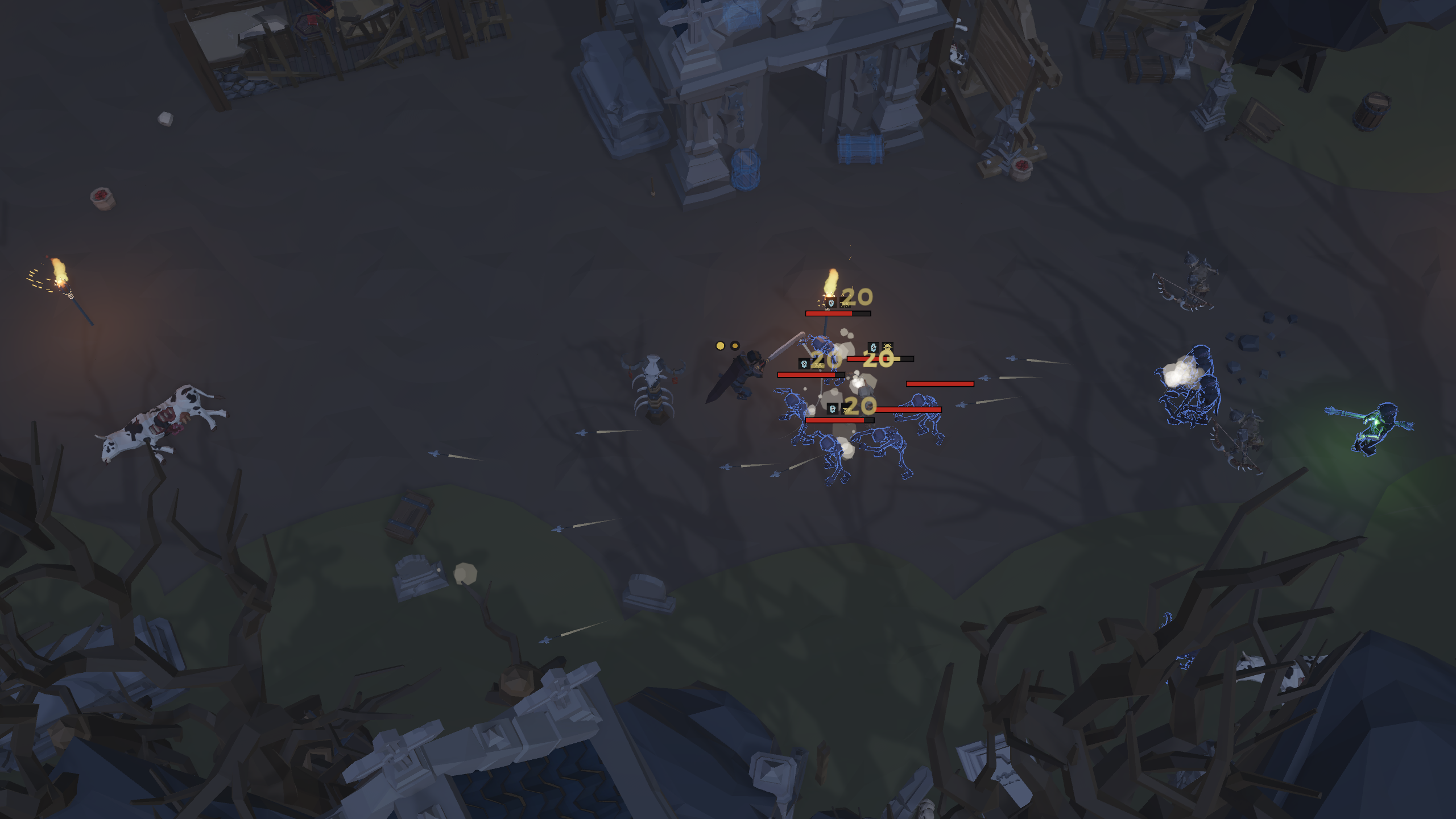
The left hand learned its trade. The off-hand had been real in the rules for a while. Shields had armor and the no-shield-with-a-two-hander restriction was in place, but the hand itself was a ghost. Equip a shield and the numbers changed while the hand stayed empty. It turned out shields had been rendering all along, onto a hidden duplicate of the character's skeleton at one percent scale, invisible forever. Everything that attaches to a hand now anchors to the live skeleton, and a Tower Shield finally looks like a Tower Shield. It's held on the forearm, tuned by hand across all nine shield meshes, with a proper sword-and-board stance. Spellbooks moved house in the same round. A book was technically a weapon you swung, which was nonsense on every level, and it is now an off-hand focus, held open in the left hand and feeding the defensive item pools. Then came dual wielding. Any one-handed weapon can ride the off-hand, and the sword trail only lights on the blade that is actually striking. A left snap lights the left trail, a right arc lights the right one, and the double sweep lights both. Those dual-wield strikes are a v1, carved from a single sample combo animation. They read as real attacks now (three review rounds taught us that sped-up motion capture with no wind-up reads as noise, because attacks need their anticipation frames), but dedicated per-weapon dual animations, and off-hand damage that actually counts, are their own rounds later.
The ranged slot had been a stat line with no body. You could wear a bow next to your melee kit and nothing about your character admitted it existed. Now a worn bow, crossbow, or wand renders stowed across the back. All 97 weapon bases got a hand-tuned stow pose in one heroic tuning session, because the moment the swap existed, any weapon could end up back there. Draw your bow and your greatsword takes its place between your shoulders. The swap is one key. Z trades your active kit, and the swap is animated. The character reaches back, and the weapons change place at the exact moment the hand crosses the shoulder. The shot has some game-feel opinions baked in. The attack button is context-sensitive, so with the bow drawn it draws. Hold to nock a visible arrow, pull to full draw and track your cursor, then release to loose. Release too early and nothing flies. A full draw is required, and a soft click tells you the string is set. That single rule kills spam-clicking and gives archery its own rhythm. You draw, settle, and loose, and it feels nothing like melee. The arrow is a real projectile that carries the bow's damage into the same resource-on-hit economy as a swing. The crossbow plays the same song in a different register, carried like a rifle and aimed from the shoulder.
A sword on your back, a bow at full draw, and a shield that finally shows on the arm are now all one key apart. Still open on the ledger: a proper feel pass on crossbow bolts in live combat, and teaching the tooltips to talk about ranged damage.