A loot game that exists only on paper is a spreadsheet. Over these builds all of it arrived on screen, with an inventory you drag things around in, a character sheet that explains itself, and three skill trees you can actually climb. Then the game grew a room worth returning to, which is what every loot game needs most.
First, the loot game grew hands. The inventory went through seven verdict rounds in a single day and came out as a proper body-shaped paperdoll, with the main hand and off-hand flanking the armor and a bag with tabs for items and aggregated currencies. Tooltips speak the genre's language now, with white base lines that show the possible roll range in parentheses, requirements that turn red when you fall short, and every rolled modifier in magic blue. The character sheet derives every number end-to-end on hover. It shows what each point of Strength does to your weapon damage, how armor becomes a reduction percentage, and where your life total comes from, with breakpoint ladders printed in full. The three skill trees tripled to forty nodes laid out in level bands with directional arrows, and they explain themselves too. Hover a node and its whole web lights up, blue for what feeds it and green for what it boosts. Each tree bottoms out in a keystone framed in corrupted dark red. And the off-hand became real, with a buckler family across three quality bands and the classic two-handed rules enforced in the data. A greatsword greys the shield box out, a lone shield politely returns to your bag, and a swap with both hands full is refused with a red flash instead of eating an item.
Every loot game needs somewhere to stand still and empty your bags, so this round built the Pilgrims' Camp, a home you can walk around in. It's a refugee huddle inside a stockade of sharpened stakes, with one gate facing the road you arrived on and seven tents in two rough arcs around a central bonfire. It is night, and that turned out to be the whole trick. The camp is lit almost entirely by its own fires, warm pools of light with black between them, so the palisade reads as shelter rather than the edge of the world. The camp evolves as the campaign moves on. It stays one hub that gets dressed differently, and there is no new town per act.
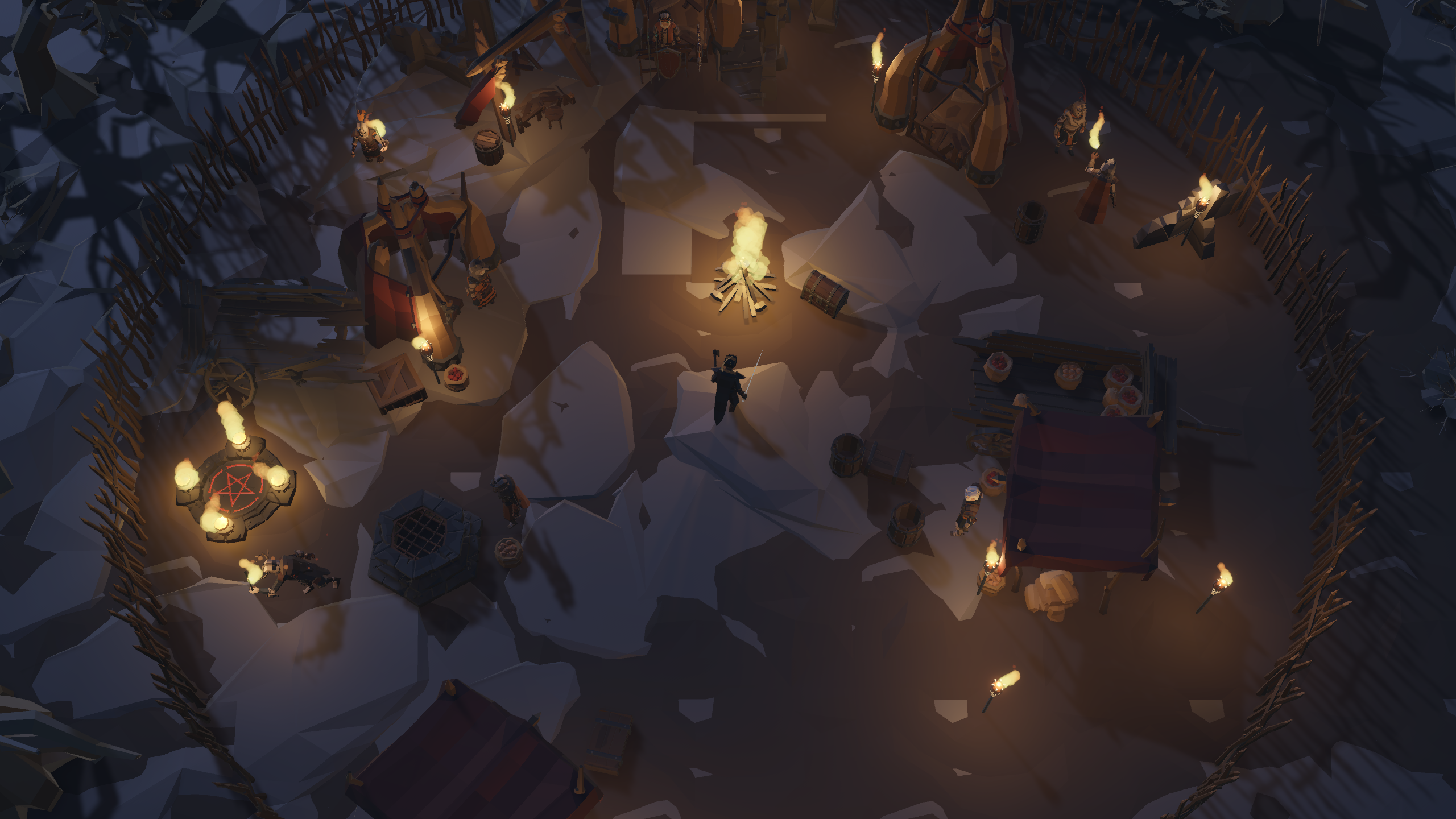
Three of the survivors trade: an Armourer, a Weaponsmith, and a general trader, each with a shelf dense with the thing you came for. Their stock refreshes on the hour or when you die, priced slightly above your level so a shop can occasionally bridge a gap your drops haven't. Selling pays a quarter of what buying costs, and that is deliberate. It keeps vendoring loot from becoming your income, and it makes every purchase a choice. There's a stash by the fire too. It's a bank twice the size of your bags, with gold and crafting currency kept apart from gear.
Then the camp got its voice. Before that it had bodies in it but made no sound, so you walked through sleeping survivors in silence, opened a shop that made no noise, and stood by a bonfire you could see but not hear. A library of 227 clips across 86 groups went in, all of it regenerable from raws kept beside the project, so nothing shipped is precious. Everything became positional. The three vendors greet you, comment when you buy, and grumble when you can't afford something. Survivors mutter across the fire, and a faint bubble appears over whoever spoke, so an overheard voice has a body attached to it. The barks come from whichever survivor is actually near you and never from a single hidden emitter. When a vendor speaks, the chatter cuts off mid-word, because two voices at once reads as a bug. One number made it all work. The engine randomises pitch by ±8% so repeated sword hits don't grate, which is exactly right for foley and a disaster on a human voice. It comes to about a semitone and a half, enough that the same character sounds like a different person on every line. Voices now route through their own call that forces the randomisation to zero, so it can't be forgotten at a call site.
Next, the new weapons get something to look like in your hands, and the hero's gear finally shows on his body.