Until now the Penitent knew five tricks: a basic combo, a whirlwind, a big cleave, a lunge, and a healing circle. The talent trees promised more. Nine actives were designed into them, but pressing those buttons did nothing, because the skills existed only as tooltip math. This stretch was one long forge session that built them all, kept going, and then handed the whole roster to you to reshape.
The nine promised skills are real now, and the forge invented three more. Warfare got its execute and a capstone that lands the hardest blow in the game. Sanctity became a proper caster kit. You can hurl a burning censer that bursts in embers, throw a lance of light that flies until it finds a skull, raise a moonlit ward that slows and sears, and detonate everything around you in rings of gold. Mortification trades in its true currency, your own blood. Open a vein for a surge of resource, wreathe yourself in pain that makes every strike heavier the more you've bled, or immolate a third of your life in a crimson blast. Then came three the plan never asked for: a branding strike whose damage arrives over the seconds after the blow, a lit-censer toggle that burns anything walking through its smoke, and an airborne leap that ends in a staggering slam. The bigger win is underneath. Projectiles, thrown arcs, self-detonations, timed buffs, toggles, damage-over-time and an aerial arc are all engine shapes now, so the next skill of any of those types is a dozen lines of data.
Then every skill grew three faces. Fifty-one runes now exist, three per skill, and each rune re-imagines its skill instead of giving it a stat bump. The whirlwind can become a tighter, thirstier cyclone or a broad, cheap gale. Judgment can trade its focused sentence for one colossal blow, or for a wide arc that condemns the whole crowd for less each. The marquee runes are elemental. Dreadmark already tracks fire, cold, lightning and poison, each with its own ailment, so a rune can convert a skill. Emberslash makes every basic swing burn. Frostcleave freezes what it hits hardest, and Stormeye leaves everything inside the whirlwind shocked. Twelve skills can turn to a whole new element this way, ailment and all.
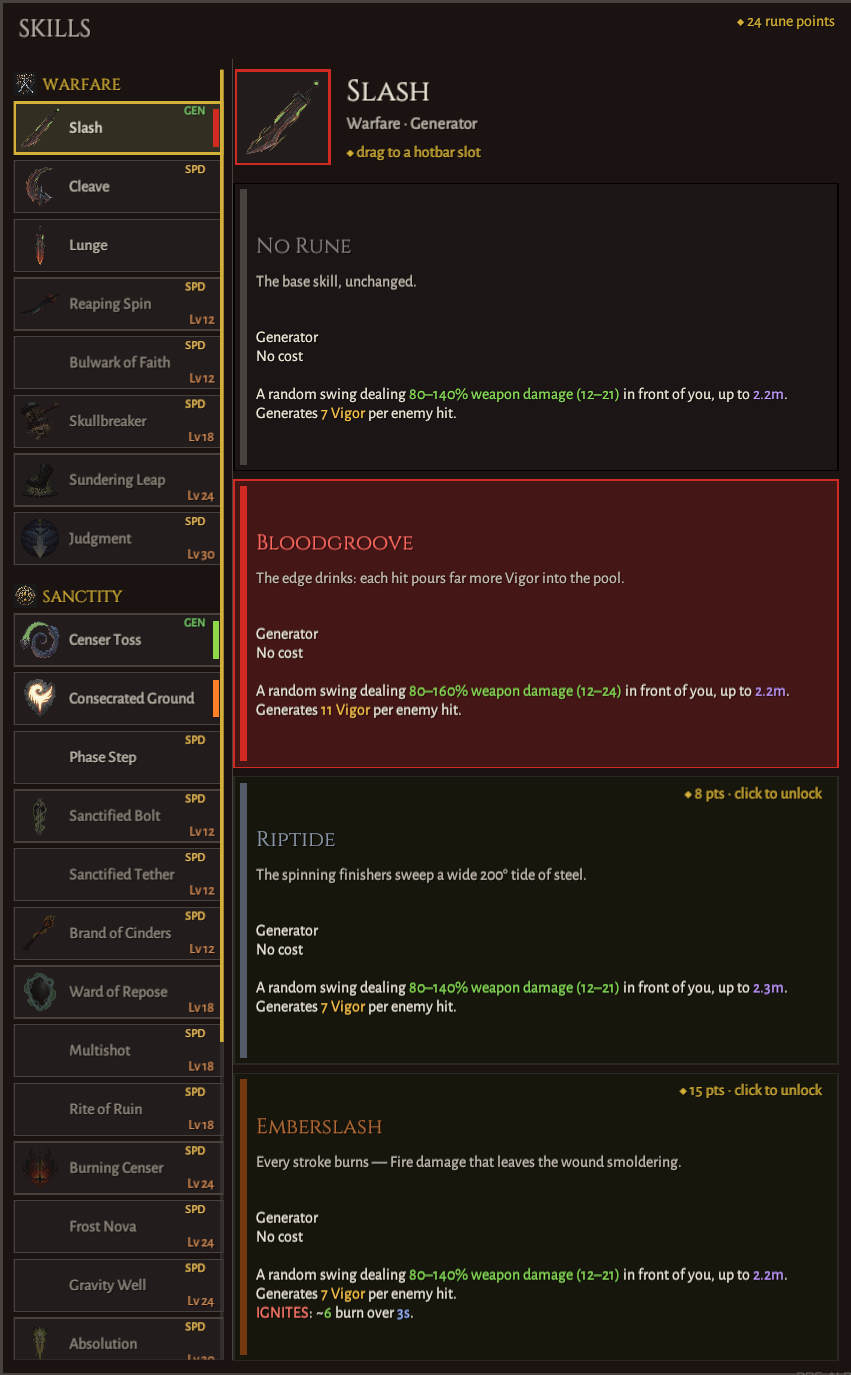
Choosing them has its own screen, and nothing is handed to you. A new skill window lays your kit out like the classics did. Pick a skill on the left and its runes appear on the right, each shown large with its actual resulting numbers, so you can theorycraft at a glance. Then drag the skill onto your hotbar with the rune baked in. Skills unlock as you level, though, and runes cost rune points, a currency you earn a little of each level and find as Rune Shards dropped by elites and bosses. You won't unlock everything on one character. The strongest, widest runes cost the most, and the best of them sit deliberately further up the ladder than a short demo run can reach. There's a full game up there.
The darkest additions open whole new ways to play. Phase Step is a violet blink that snaps you to solid ground and refuses to strand you in a wall. Mark of Penance is a thrown curse. The foes it touches take more of your damage, deal less of theirs, and drag their feet. Rite of Ruin is its payoff. Stack poisons and burns on a pack, throw the Rite in, and every ailment erupts. For the first time, an ailment build has a finisher. Gravity Well opens a void-violet singularity that hauls a spread pack into a knot, then collapses on it. The headline is Raise the Faithful. Pale spectral acolytes rise around you, break off to chase the nearest enemy, and cut it down while you handle the rest. The summoner fantasy is finally in the game.
The numbers are still settling, but the kit is finally deep and dark, and it's yours to shape.