Last time out, we said the deepest part of a class — the pathing, the hard choices that make a build yours — was the next thing we were rebuilding from the ground up. This build is that rebuild, and it starts with the Templar himself. For most of Dreadmark's life he was the simple one: the pilgrim who solved problems by closing the distance and swinging until they stopped. It worked, but it never really said anything. Now it does. The Templar is a sword-and-board holy crusader, and his whole art runs through the slab of iron on his left arm.
The shield is the engine. Raise it and blocking a blow doesn't just save you — it pays you, banking the Vigor that fuels everything else. So the loop inverts: you don't spend a turn defending and a turn attacking, you defend in order to attack. And the shield itself is a weapon now. You thrust with its edge to open a lane, charge behind it to plough a pack off its feet, and hurl it like a discus so it flies through the line and comes spinning back to your hand. The marquee skills ask for a shield in your off-hand on purpose — this is a stance, not an accessory.
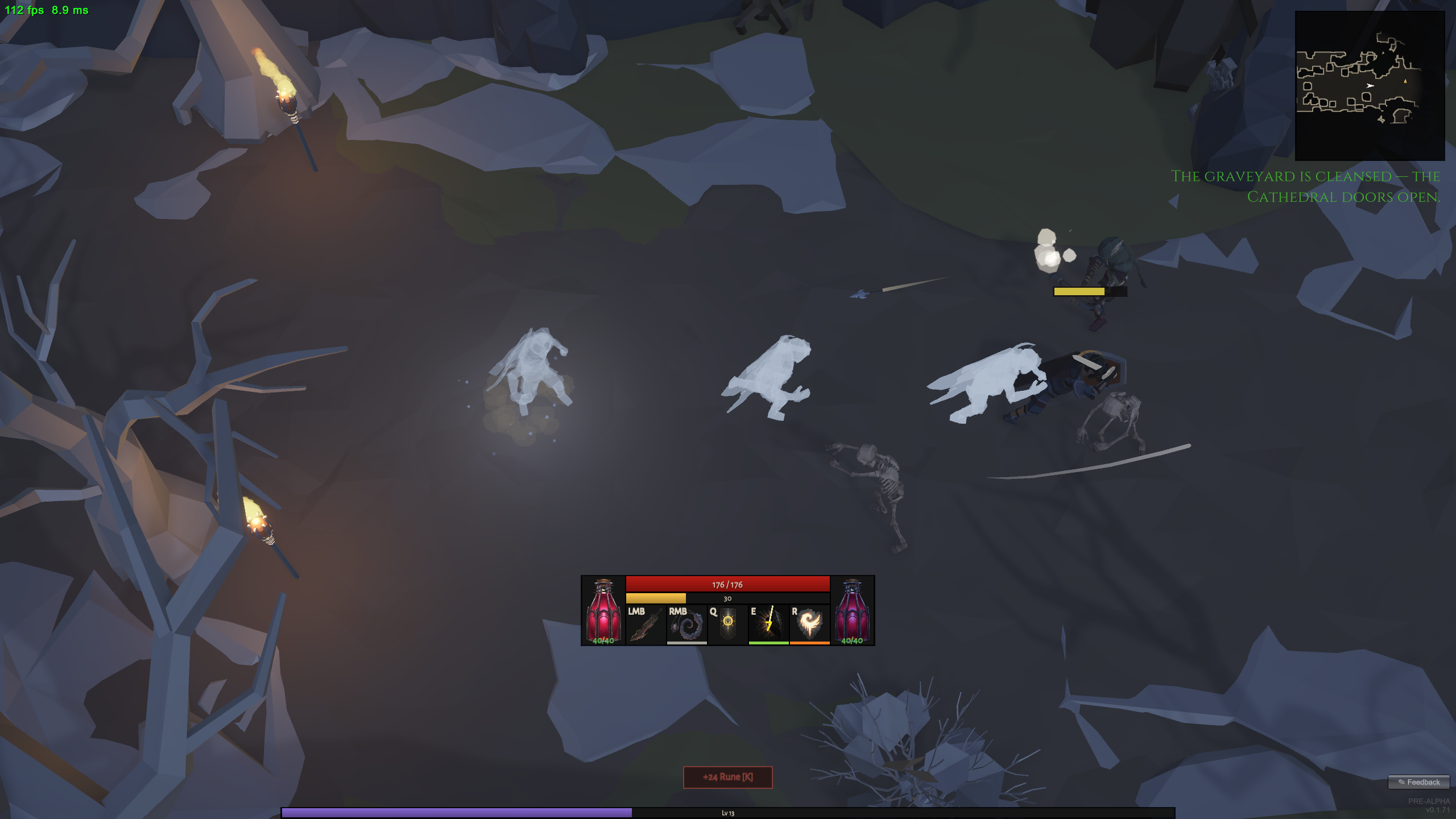
Take the blow, then answer it. The best Templar play is reactive. Time a block and the shield bashes back on its own. Plant a bastion of holy iron in a doorway and hold the line while enemy shots die against it. And when the pressure really comes, let it: the Retribution stance quietly banks every hit that lands on you — blocked or not — until you release the whole ledger at once as a ring of holy force that hits harder the harder they hit you. Wear the Crown of Thorns and their own blows break against you. Fight and block long enough and Zeal takes hold — a rising holy fervour that makes every strike land heavier, earned in the thick of it rather than bought.
Three roads out of the same camp. Warfare is the shield as a weapon — thrust, charge, throw, a leap that cracks the ground, and a judgment to end it. Sanctity is the faith — censer-fire lobbed into a crowd, consecrated ground that burns and mends, elemental brands, and holy novas that clear a room. Retribution is the shield and the thorn — block, counter, walls, and reflected wrath, the tree for the crusader who wins by refusing to fall.
Runes that change the spell, not just the number. A rune can turn a swing to fire, frost, or lightning; make a skill scale off your Strength, your Agility, or your reserves of holy Energy; or reshape it into something else entirely — a thrown shield that chains, a counter that erupts in a shockwave, a wall that heals its keeper. One skill, several honest ways to play it.
And a cleaner faith. The old road had a streak of self-harm to it — bleeding for power, seeding rot. That's gone. This Templar draws nothing from his own wounds and spreads no poison; his strength is endurance and retribution, the shield that turns a beating into a weapon. It's a holier, harder figure than the one we started with — and, at last, one that knows exactly who he is.
The martial road finally has a backbone. The numbers will settle with play, but the identity is set: raise the shield, take the blow, and make them regret the swing.