Every loot game needs a room you return to. Somewhere to stand still, empty your bags, decide what was worth carrying. Dreadmark has had graveyards and a cathedral for weeks; what it didn't have was a home.
This round built the Pilgrims' Camp.

A camp, not a menu
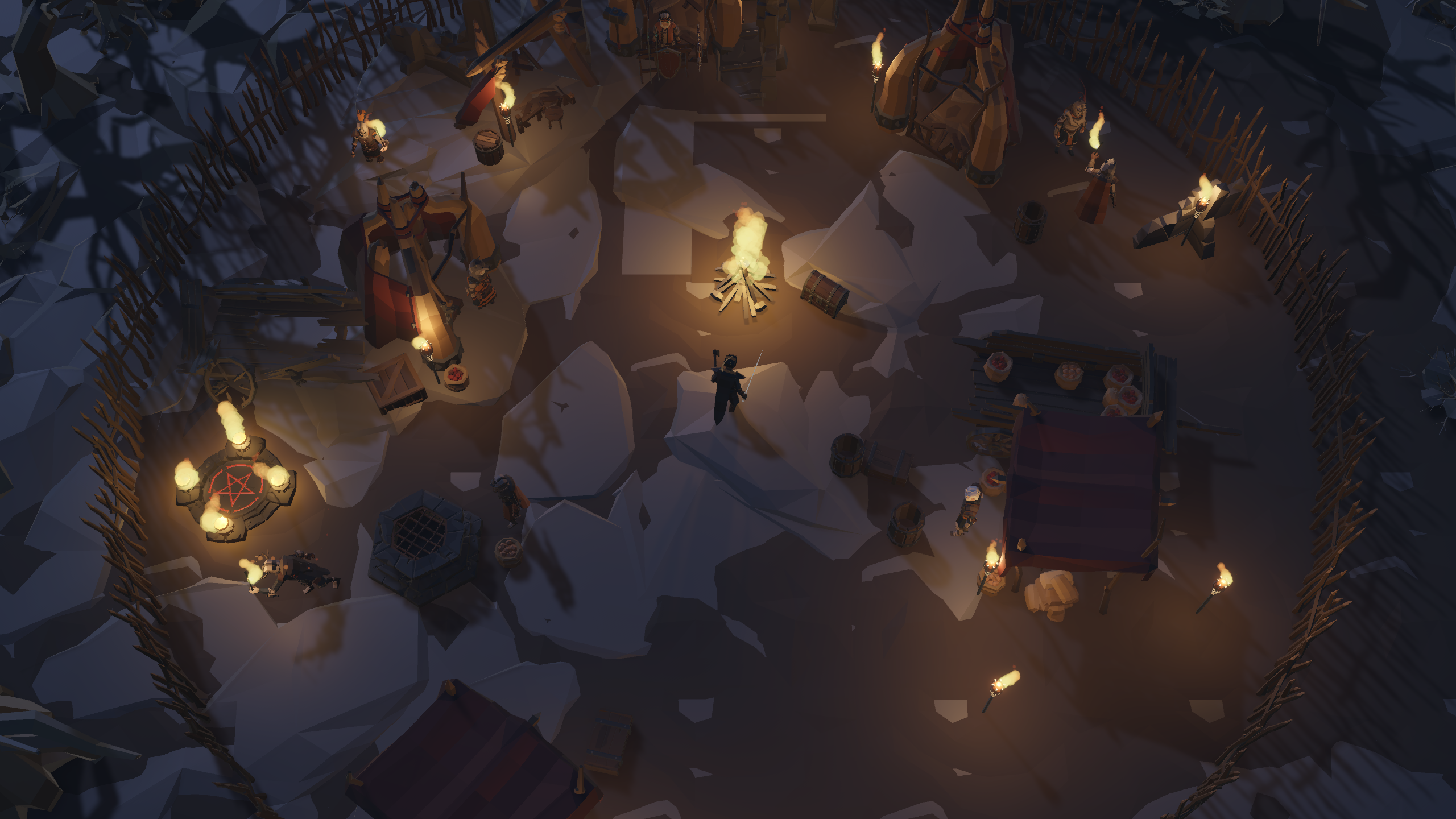
The camp is a refugee huddle inside a stockade of sharpened stakes, with one gate facing the road you arrived on. Seven tents in two rough arcs — an inner working ring around the bonfire, an outer row where people actually sleep, because a camp is mostly sleeping arrangements and it looked absurd with three. Wagons, a well, barrels, sacks of whatever could be carried out.
It is night, and that turned out to be the whole trick. The camp is lit almost entirely by its own fires: the bonfire at the centre, torches ringing the stakes, one at each tent. Dark on its own is just a dark field — what makes it feel like shelter is the pool of warm light with black between it. Outside the fence a dead-tree woodland thins away into the distance, so the palisade reads as a boundary rather than the edge of the world.
The camp evolves rather than multiplies: one hub dressed differently as the campaign progresses, instead of a new town per act.
The people in it
Three of the survivors trade. An Armourer, a Weaponsmith, and a general trader, each keeping a shelf of what they actually deal in — a specialist's window is dense with the thing you came for, which is what makes walking to them a decision. Their stock refreshes on the hour, or when you die, and it is priced slightly above your level so a shop can occasionally bridge a gap your drops haven't.
Selling pays a quarter of what buying costs. That gap is deliberate: it keeps vendoring loot from becoming your main income, and it means the things you buy are chosen rather than accumulated. If you sell something you shouldn't have, the vendor will sell it back — at full price, which is its own small lesson.
There is also a stash by the fire now: a bank twice the size of your bags, with gold and crafting currency kept separate from gear.
Weapons that disagree with each other
Alongside the camp, the armoury grew from one sword family to eleven. Swords, axes and maces in one hand or two, greatswords and mauls, staves, and bows, crossbows and wands. One-handers can be paired, and dual wielding averages the two weapons rather than simply stacking them — two good weapons is a real choice, not free damage.
Armour split three ways as well: light, medium and heavy at every quality band, so a ranger and a warrior can both be wearing the best gear in the game and look nothing alike. Light armour asks for agility instead of strength — it is the dexterous build's armour, not merely the cheap option.
Next: making the stash feel like a stash, and giving the new weapons something to look like in your hands.