The last entry ended with a loot game that existed only on paper. This one ends with all of it on screen: an inventory you drag things around in, a character sheet that explains itself, three skill trees you can actually climb — and, as of tonight, a shield hand with real rules. It took a week of build-play-verdict rounds to get here, and the game looks like a different game.
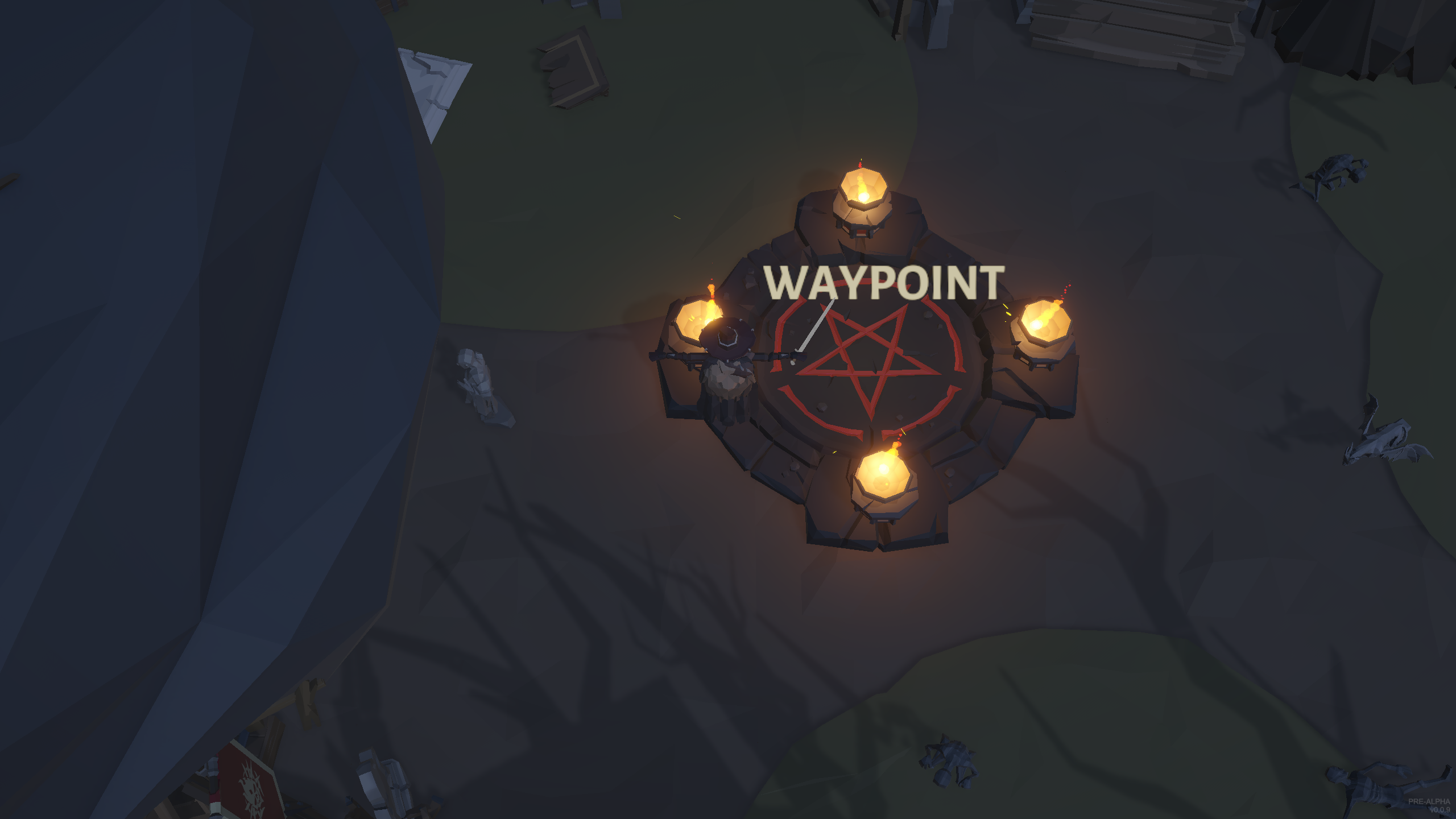
Travel came first. Waypoints are now ritual circles carved into the rock: walk onto one and its four candles light, click it and a travel panel opens. They persist for the session across every zone, which quietly turned the three maps into one connected world. Death got the same care — a real death animation, monsters that lose interest and wander off, the HUD folding away so the moment lands. And spawning got honest: every monster pack now proves it has a walkable path to you before it appears, always off-screen, with a watchdog that quietly relocates anything that wedges itself into scenery. (That watchdog had one last laugh today — a path-scratchpad allocated in the wrong place froze the whole outdoor map at frame one. Found while taking the screenshots for this very entry, fixed the same hour.)
Then the art arrived. A full drop of painted UI: item icons, slot glyphs, stone-arch panel backdrops, per-zone loading screens, and cursor art — right-click a crafting orb and your cursor becomes the orb until you spend it. The inventory wears a gothic arch; the character sheet sits on faded parchment-dark stone; the skill trees went moody greyscale so the gold of your choices is the brightest thing on the page.
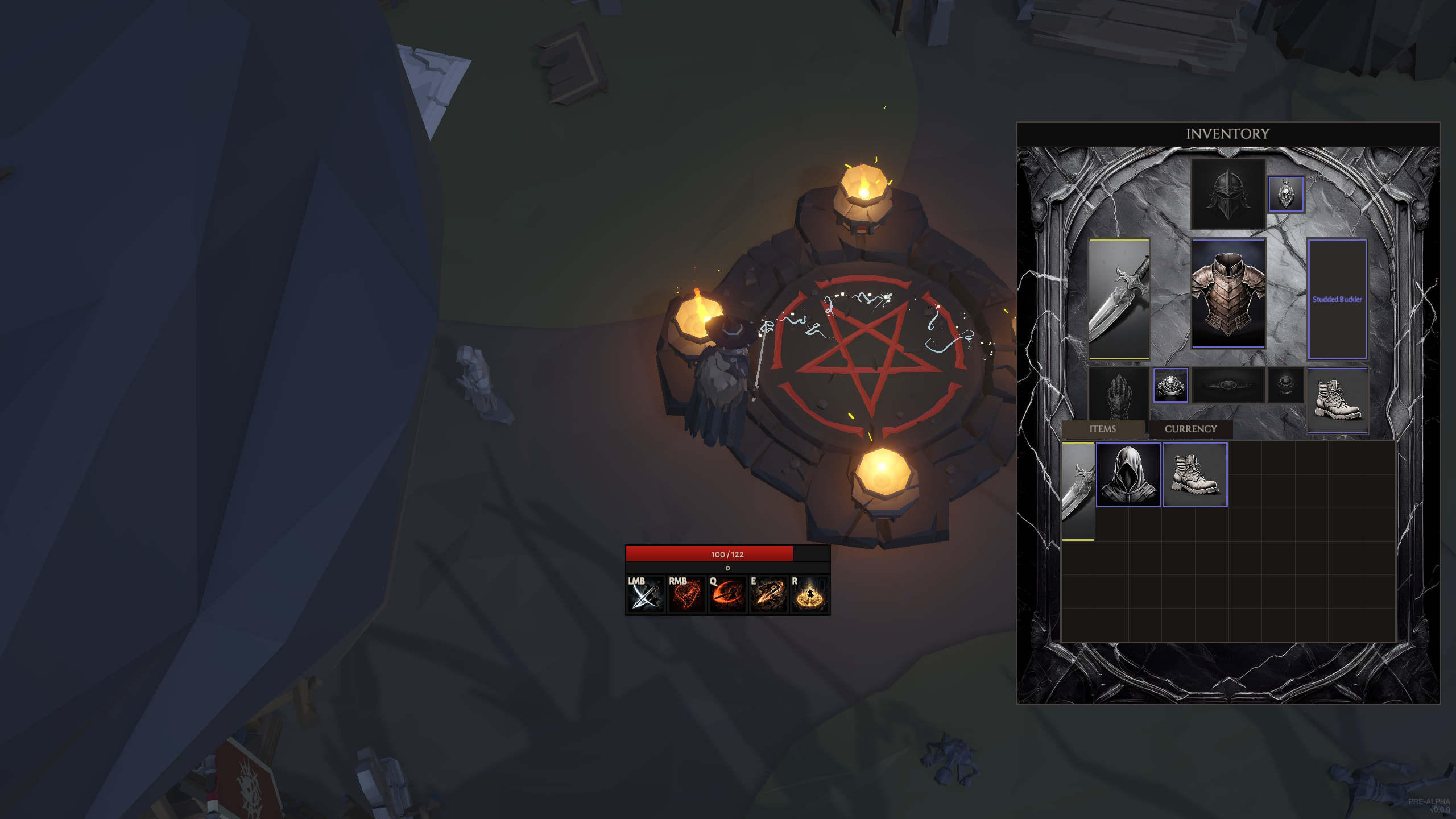
The inventory itself went through seven verdict rounds in a single day. The paperdoll is now a proper body-shaped grid — main hand and off-hand flanking the armor, gloves and boots mirrored below, rings flanking the belt. The bag got tabs: items on one, currencies aggregated into tidy rows on the other. Item tooltips speak the genre's language now — white base lines with the possible roll range in parentheses, requirements that turn red when you don't meet them, every rolled modifier in magic blue. And the whole UI signed a truce with the combat controls: clicking inside any panel never swings your weapon at the ground behind it.
Today's finish was the off-hand. Shields exist — a buckler family that climbs through three quality bands — and with them the classic two-handed rule: an elite greatsword takes both hands, greying the shield box out; if you're holding a lone shield when you equip it, the shield politely returns to your bag; if both hands are full, the swap is refused with a red flash instead of eating an item. Every one of those paths is enforced in the data layer and was verified click-by-click in the running game.
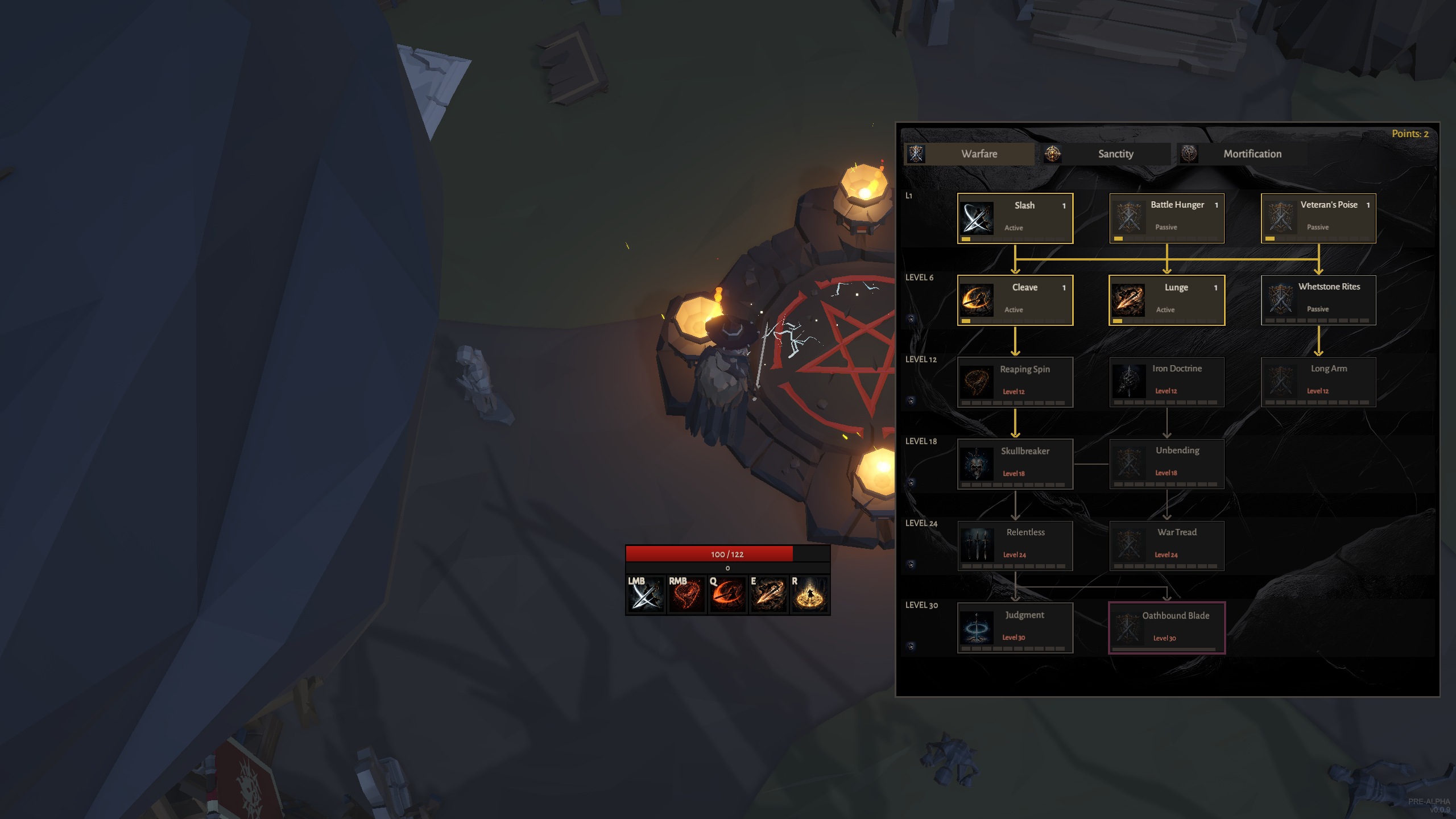
The skill trees tripled in size and learned to explain themselves. Forty nodes across three trees, arranged in level bands with directional arrows between prerequisites. Skills now synergize — points in one skill can feed damage into another, and hovering a node highlights its whole web: blue for what feeds it, green for what it boosts. Each tree bottoms out in a keystone, a one-point build-definer with a real tradeoff, framed in the same dark red as a corrupted item. Tooltips list cost, cooldown, and every synergy with live numbers — the panel does no math of its own, it prints what the systems calculate.
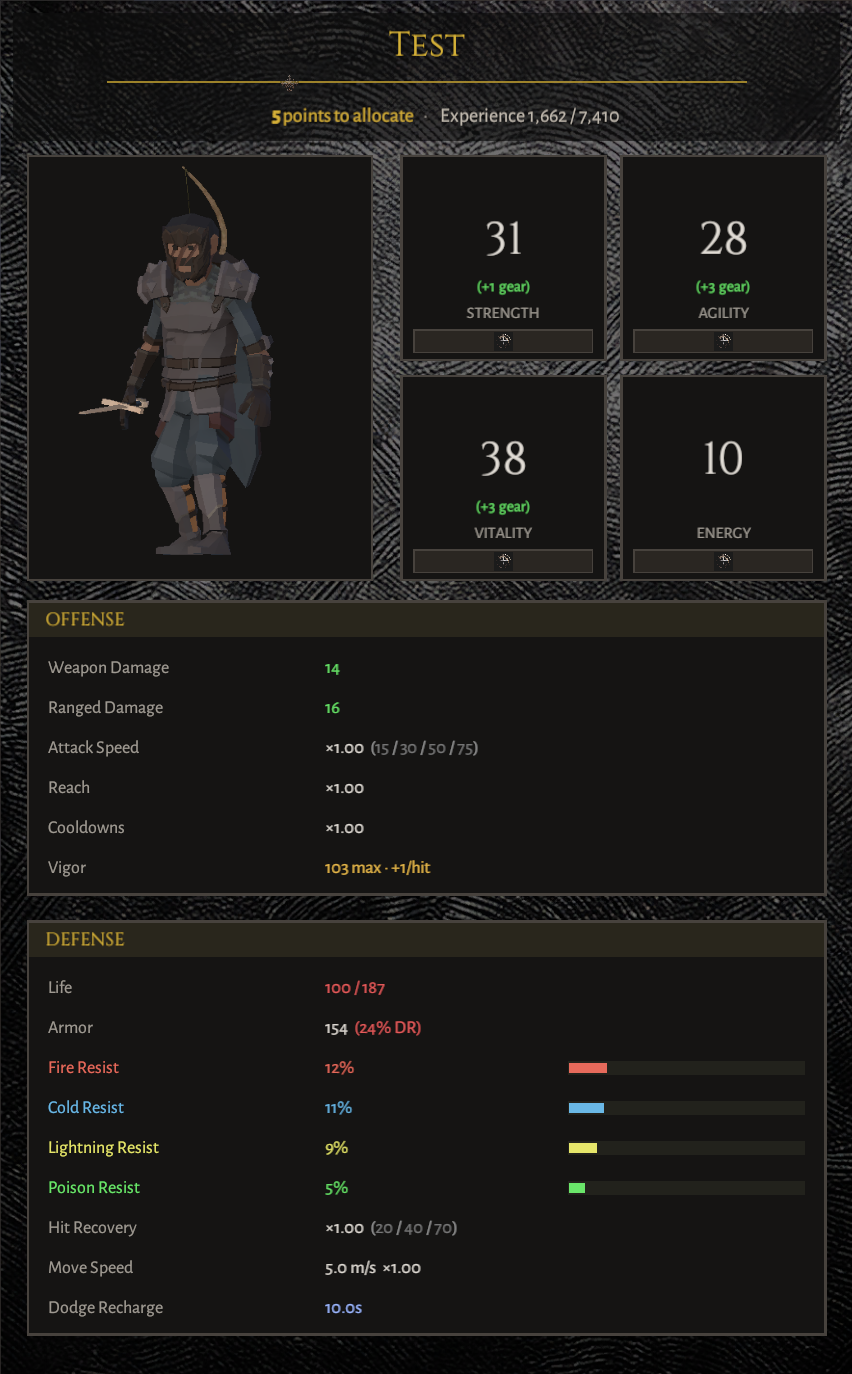
The character sheet got sections, gear bonuses in green brackets, resists in their element colors, and breakpoint ladders printed in full. Hover any stat and a tooltip derives it end-to-end: what each point of Strength actually does to your weapon damage, how your armor number becomes a reduction percentage, where your life total comes from. No mystery stats.
Combat got louder too, courtesy of a newly adopted effects library: a golden burst on level-up, treasure chests that fountain coins, a gore pop on every kill, and the witch's hex bolts landing in a splash of sickly green. Cheap, loud, and honest — every effect is clamped to frame-time budgets.
Next: the hero sheds the placeholder look — visual equipment that changes with what you wear — and after that, the crypt beneath the cathedral and the things that live in it.