Dreadmark began as a hard reset. There was an older prototype, with different tech and a different scope, and the first serious decision of this project was to disregard it entirely. Everything started over, from the engine (Unity 6, URP) to the design doc. The rule of one character first came out of that first day and has governed every day since. It means no second enemy, no item system, and no new map until the thing currently on screen looks and feels finished. The order is art, then animation, then movement, then combat feel.
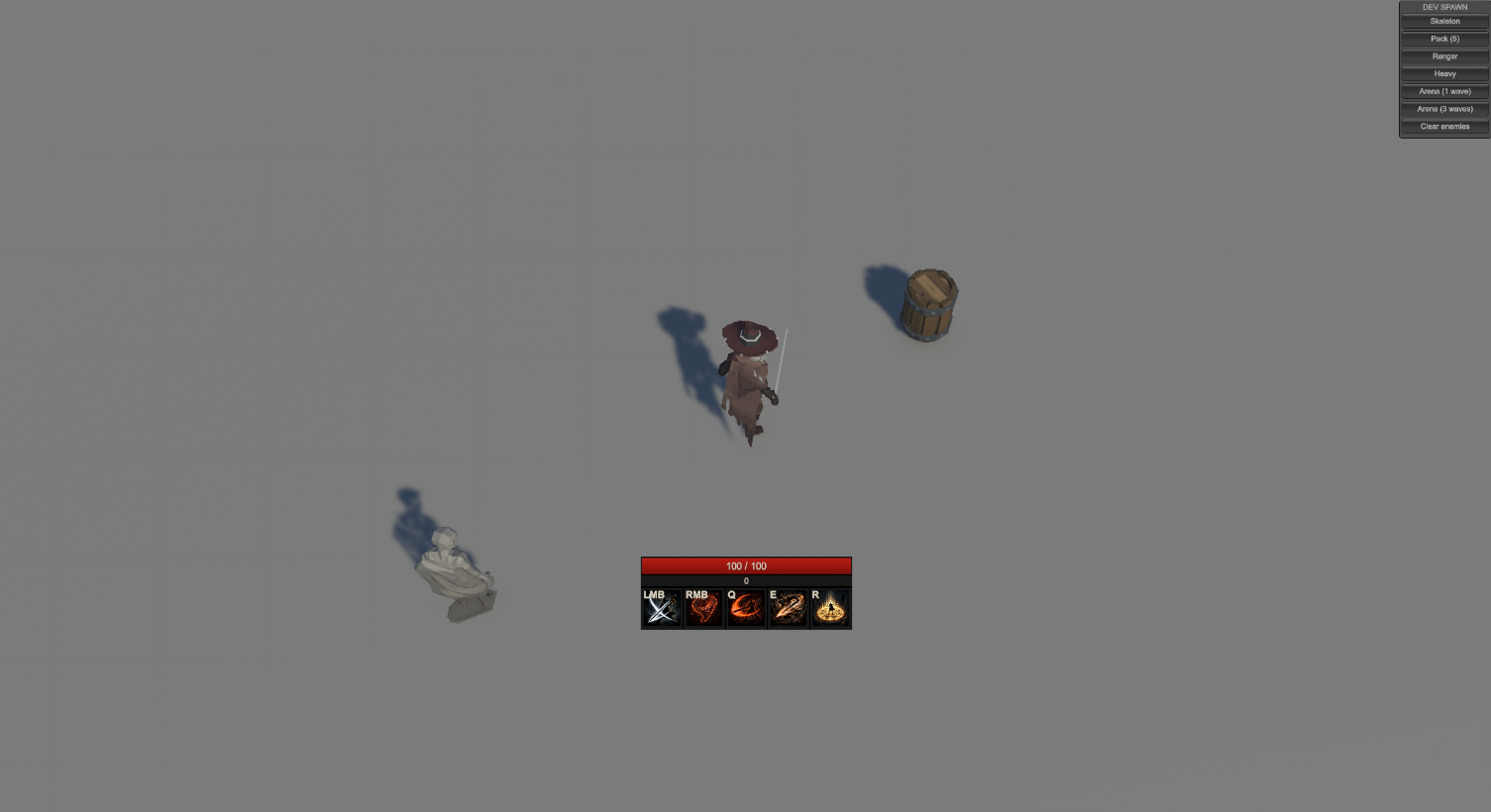
Everything happens in a single permanent test scene. It holds a plane, a light, some reference props, and the Penitent, our protagonist, who is built from a stylized low-poly pack and animated with retargeted motion capture. The camera is the genre-classic top-down isometric view, locked at the angle where ground telegraphs read clearly and swings feel weighty rather than tiny. Movement landed the same day: WASD locomotion with cursor-aimed attacks, input-buffered swing chains, and a dodge roll with invulnerability frames and two charges on a shared recharge. Those two charges make an anti-spam economy, and that would later turn out to matter enormously for enemy design.
Retargeting mocap onto the rig corrupted the character's left leg, and it nearly ended the whole thing. The foot locked at a bizarre yaw with triple the rotation range, but only during locomotion, so it was invisible at idle. Every obvious fix failed, and so did different clips. Foot IK made it worse. The culprit was the engine's humanoid retargeting pipeline itself, because its muscle-space encoding couldn't round-trip this skeleton's mirrored bone convention. The fix was to abandon humanoid retargeting entirely and import everything as a generic rig riding one shared skeleton. It's all sourced by uploading our own character to the mocap service, so every clip comes back pre-fitted. That decision shaped the whole pipeline. Every humanoid in the game, hero and monsters alike, now shares one skeleton, so every animation we acquire works for everyone.
Before any enemy existed, the sandbox got a training barrel and the full hit-feel stack: hit-pause, camera impulse, target squash-and-flash, floating damage numbers, and bone-crunch sound. The sound is deliberately rationed, so the foley always plays and the voice only rarely does. The principle, stated on day one, is that combat feel is law and every mechanic ships only when it feels right in the sandbox.
Then it became a program, because a game needs to be something you can double-click. Dreadmark got its first standalone Windows build, v0.0.2, with a version number in the corner, and the editor was freed up for the heavier testing to come. The very first .exe earned its keep by breaking. Enemy health bars were invisible in the build while working perfectly in the editor. The culprit is a classic engine trap. Shaders referenced only from code get stripped from builds as "unused," and our procedural visuals (health bars, telegraphs, every effect) conjure their materials at runtime. They're force-included now, and the pipeline re-checks on every build. With an exe in hand, ESC finally pauses the world and opens a proper menu, where you can set graphics, display mode and volume, or quit. Versioning discipline landed at the same time. Versions follow vX.Y.Z, with the patch number climbing every update. The version is always faintly visible bottom-right next to a PRE-ALPHA badge, so every screenshot and bug report is anchored to an exact build.
One last fix befit a game about being outnumbered. A standing player used to collect a polite crowd, with five skeletons swinging from one side and the rest queueing behind. Now every skeleton claims its own bearing on a ring around you, spread by the golden angle so any number of them distribute evenly, and packs close the circle around a hero foolish enough to hold still.
Next: a resource system, five skills, and a rule about wet noodles.