Dreadmark's first monster roster is three skeletons with three jobs — and one shared law: a telegraph must never lie.
The roster
- Skeleton — trash melee. Shambles in and swings. Deliberately untelegraphed: at this tier, the animation is the readability. They come in packs, and they flank — each one approaches on its own curved, sideways-biased path, so a pack fans out and arrives from multiple directions instead of forming a polite conga line.
- Skeleton Ranger — ranged pressure. Holds distance, and every shot has a quick aim-line telegraph: a thin red line that tracks you until release, then the bolt flies at where you were. Sidestepping during the aim beats it. Getting hit should feel like a missed read, never a cheap shot.
- Skeleton Heavy — the elite. 300 health, never flinches, and its big swing paints a red ground sector that fills up over a long wind-up. The fill is the timer: when it completes, the blow lands. Dodging out is the intended dance.
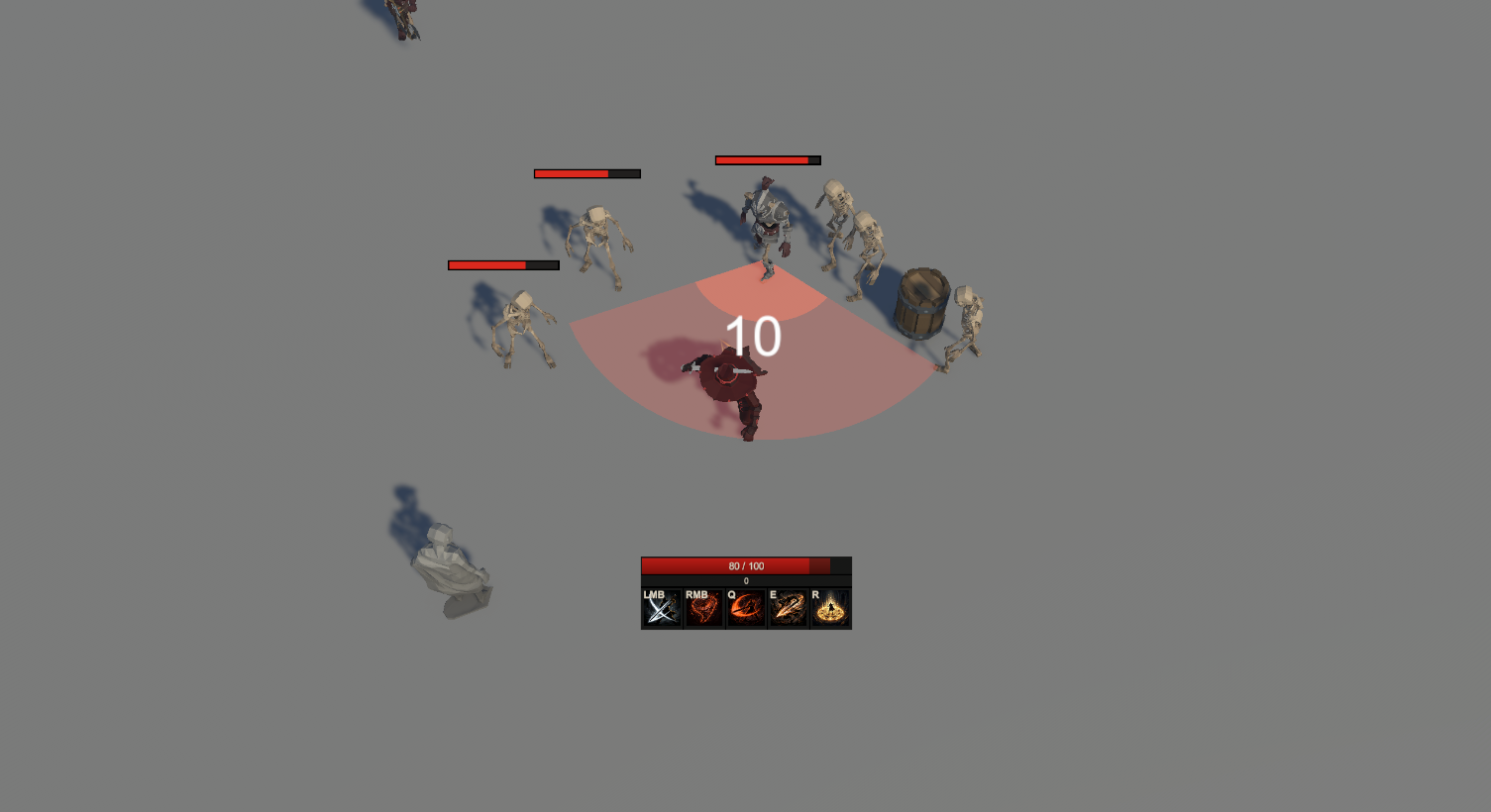
Honesty is harder than it looks
The telegraph law sounds simple. In practice, most of the roster's development time went into catching the ways a telegraph can quietly lie:
- The heavy's sector originally vanished a beat before the blow landed — sucker-punching anyone who trusted it. Now the fill completes at the exact moment of impact, wind-up plus swing travel included.
- The heavy used to keep turning while winding up — first at full turn rate (walking out was mathematically impossible), then at a reduced rate, and finally not at all: today the arc freezes in place the moment it's drawn. You can run around the monster mid-wind-up, and that's the point. Even knockback can't slide the committed arc anymore — the drawn zone and the damage zone are pinned to the same snapshot.
- The ranger once fired the frame it spawned — an unavoidable opening hit in every single test. It now needs almost a second to acquire its target, like it just noticed you.
- And when chased relentlessly, the ranger no longer backpedals forever: after a stretch of retreat it plants its feet and takes the shot, even point-blank — divers get punished, and the whole draw-and-release happens standing still, with a proper aiming stance and a stroll between shots.
Bigger, slower, better-telegraphed: that ladder — trash, ranged, elite — is the pattern the future roster (and the first boss) will climb.
Next: the monster-testing problem, solved by teaching a bot to play.