With one character moving and hitting things properly, Dreadmark got its combat spine: a generator/spender resource called Vigor, five skills, and a HUD to hold them.
The wet-noodle rule
Vigor builds from basic attacks and is spent by strong skills — the classic ARPG loop. The design rule that keeps it honest: generator abilities must hit hard in their own right — never a chore you grind through to reach the "real" buttons. Slash, the starting generator, keeps the full hit-feel stack and meaningful damage; Vigor is a bonus on top of a good attack, not the attack's only reason to exist. No wet noodles.
Skills follow a deliberate cost grammar: a skill may cost Vigor only (spam it if you can afford it), cooldown only (utility, gated by time), or both. And every skill deals X% weapon damage + Y — weapon damage is the single scaling stat that future itemization will feed, and every tooltip prints the live formula, color-coded.
The kit
- Slash — the generator: four randomized swing animations (never the same twice in a row), wide arcs, builds Vigor per enemy hit.
- Cleave — the payoff: one clean, huge 180° frontal arc.
- Reaping Spin — a held whirlwind that drains Vigor per second while you steer it. It has no animation clip at all: the game freezes a mid-swing pose and spins the character in code, and the sword trail draws the ring.
- Lunge — a cooldown gap-closer: dash to the cursor with i-frames, the strike landing as you arrive.
- Consecrated Ground — a sanctified gold circle at the cursor that burns the undead inside it and heals you for standing in it.
Spenders got their own visual language: amber effects mean "this cost Vigor" — amber sword trails, amber cast bursts, amber shockwaves.
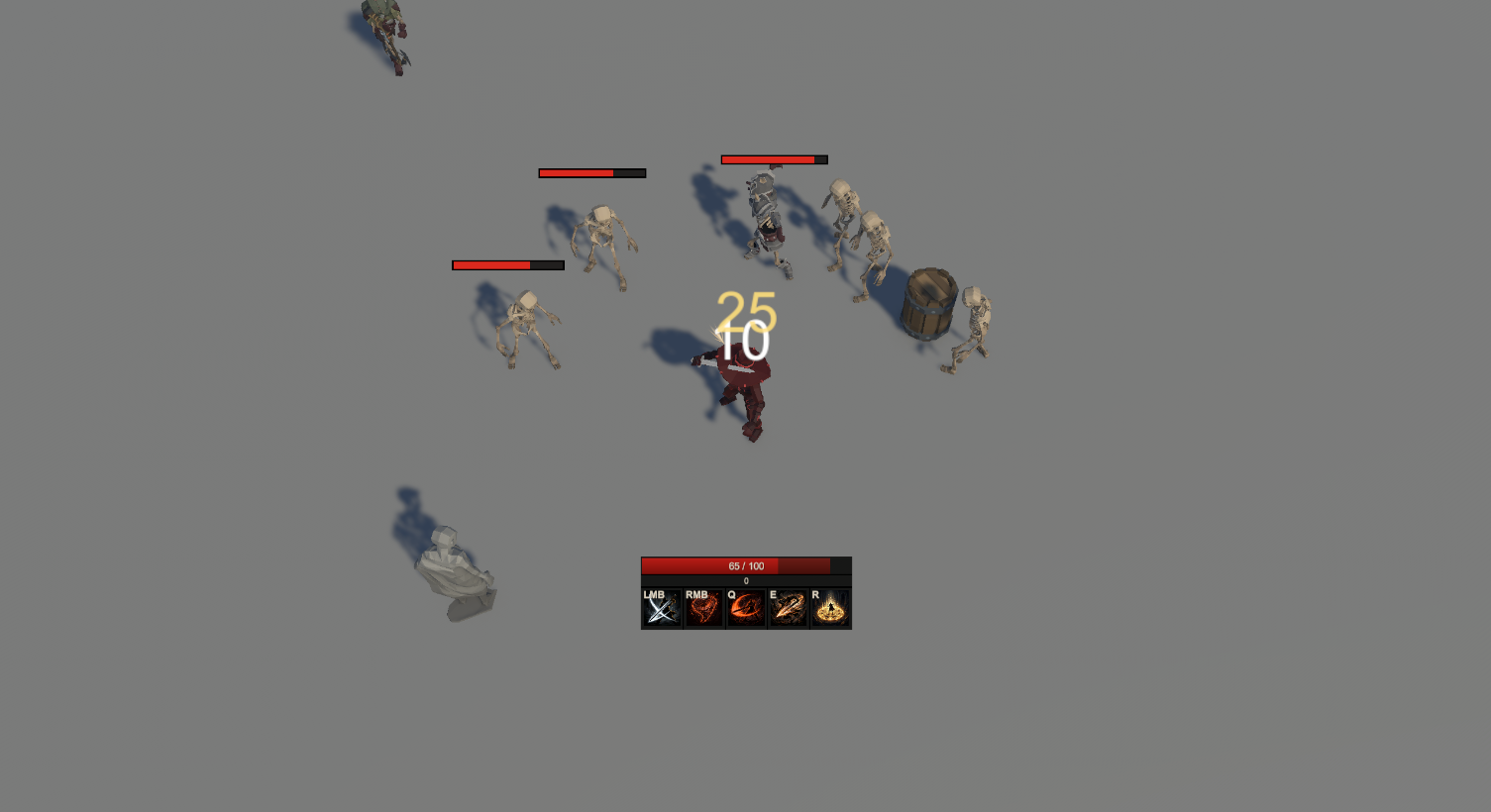
A HUD like a WeakAura pack
The HUD is a compact cluster sitting just under the character: health bar over Vigor bar over a row of square skill slots with proper cooldown sweeps, and dodge-charge pips. Everything sits flush, sharing single divider lines — flat, crisp rectangles only, after an early attempt with rounded corners read as mush at gameplay scale.
And it's fully player-configurable from day one: an unlock mode with a fullscreen grid, per-element dragging, snapping, resize and rotation, persisted per machine — plus drag-and-drop skill rebinding on the bar itself, with hover tooltips generated from live skill data.
Next: monsters — and the rule that a telegraph must never lie.