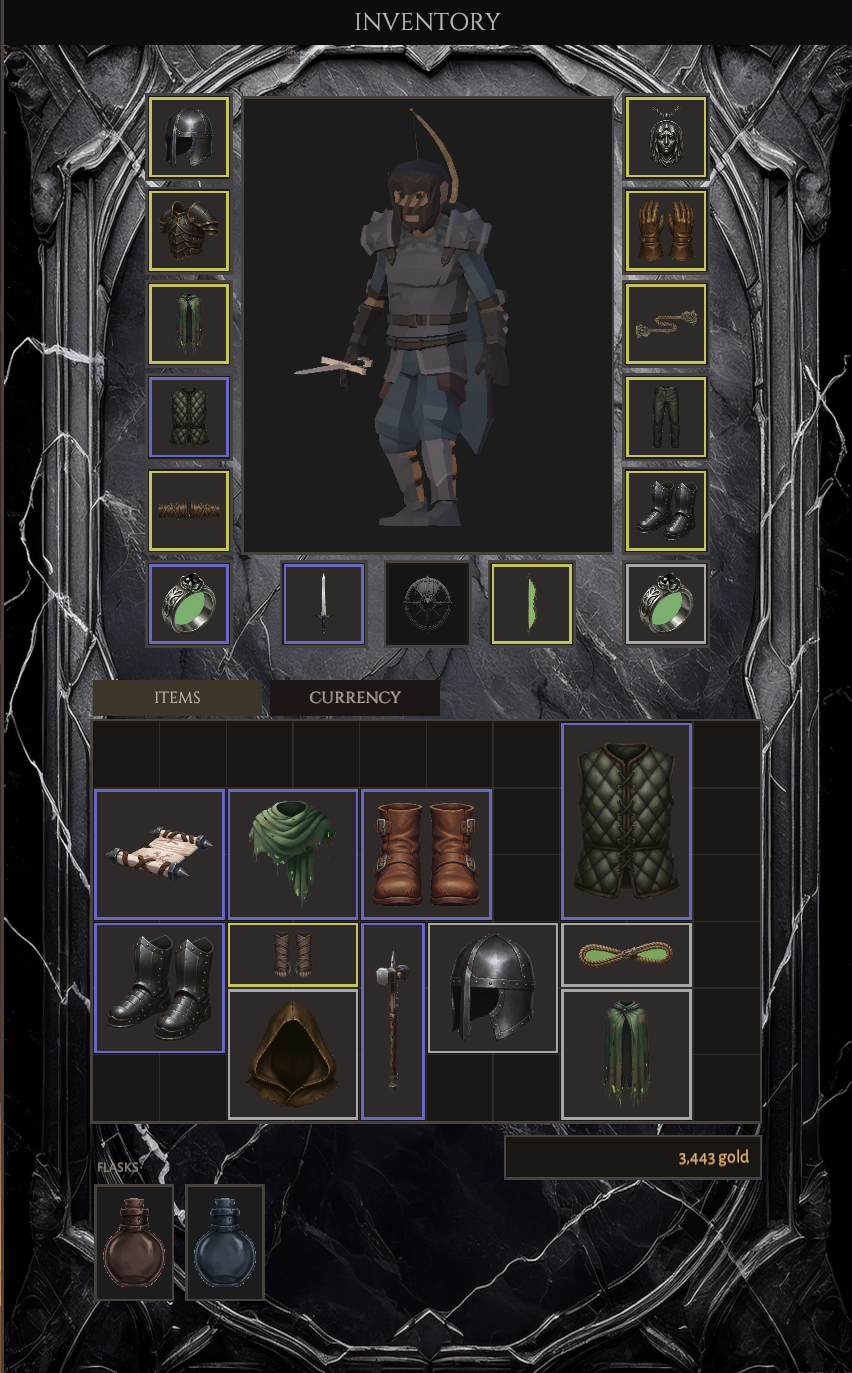
This round nothing new moved on screen — and it might be the biggest day the game has had. While one workstream kept dressing the cathedral, a second one sat down and built the entire loot-and-character layer of the game as pure data: items, affixes, crafting, corruption, attributes, skill trees, a campaign, and the math that ties them together.
The item system is a deliberate blend of the games we love. Items roll prefixes and suffixes from a pool of 33 affix families, each with five tiers gated by the level of the zone that dropped them — a starter-zone drop can only roll the trash tier, and the top tier doesn't exist below endgame content. Bases come in three quality bands with strength and agility requirements, so a late-game weapon is something you build toward, not just find. Attack speed and hit recovery are floating stats with breakpoints: seventeen percent does nothing more than fifteen until you cross thirty — gearing becomes a small puzzle instead of a bar to fill.
Crafting is a set of eight droppable currencies — reroll this, upgrade that, wipe it clean and start over. And on top sits the gamble that named the game: a rare consumable that Dreadmarks an item. Three times out of four you get a modifier stronger than anything the item could normally roll — the only source of +2 to all skills is a corrupted amulet. One time in four, the item is rerolled into something random. Either way it's branded, locked, and done. One use, ever.
The character underneath got Diablo's bones: four attributes with five points per level, three skill trees with a point-per-level and capstones at level thirty, and a three-act campaign — a blighted parish, the crypts beneath it, and the cathedral above — tuned so finishing the story lands you at level thirty, exactly when your capstone unlocks and the endgame tiers begin.
Here's the part that still feels slightly unfair: all of it already works. Every system runs outside the engine, hammered by simulation — a hundred thousand simulated kills to tune how stingy a skeleton should be, thirty thousand random crafting sessions to prove no sequence of orbs breaks an item, three builds leveled one to fifty to check nothing runs away. The simulations caught real bugs and even redesigned a skill: elemental builds fell off at high level, so the Sanctity tree grew a multiplier node to fix it — before a single item has ever dropped.
Next: wiring it into the world, starting with one cathedral demo where skeletons finally drop something worth picking up.