Today the loop changed: instead of the bot testing alone, the designer watched runs live, called out everything that looked wrong or dumb, and then picked up the controls himself — with the game logging every step, swing, and dodge of human play at the same fidelity as bot play.
Arena mode
Testing needed better opposition than hand-placed skeletons, so the sandbox got a proper combat arena: three waves, each of eight skeletons, two rangers, and a heavy. The next wave spawns the moment the current one is down to its last monster. Every wave picks a fresh random anchor on a ring around the player — always spawning away from you, never on top of you — and individuals scatter around it. An on-screen dev panel now spawns anything mid-play: singles, packs, a one-wave arena, the full gauntlet, or a clean wipe.
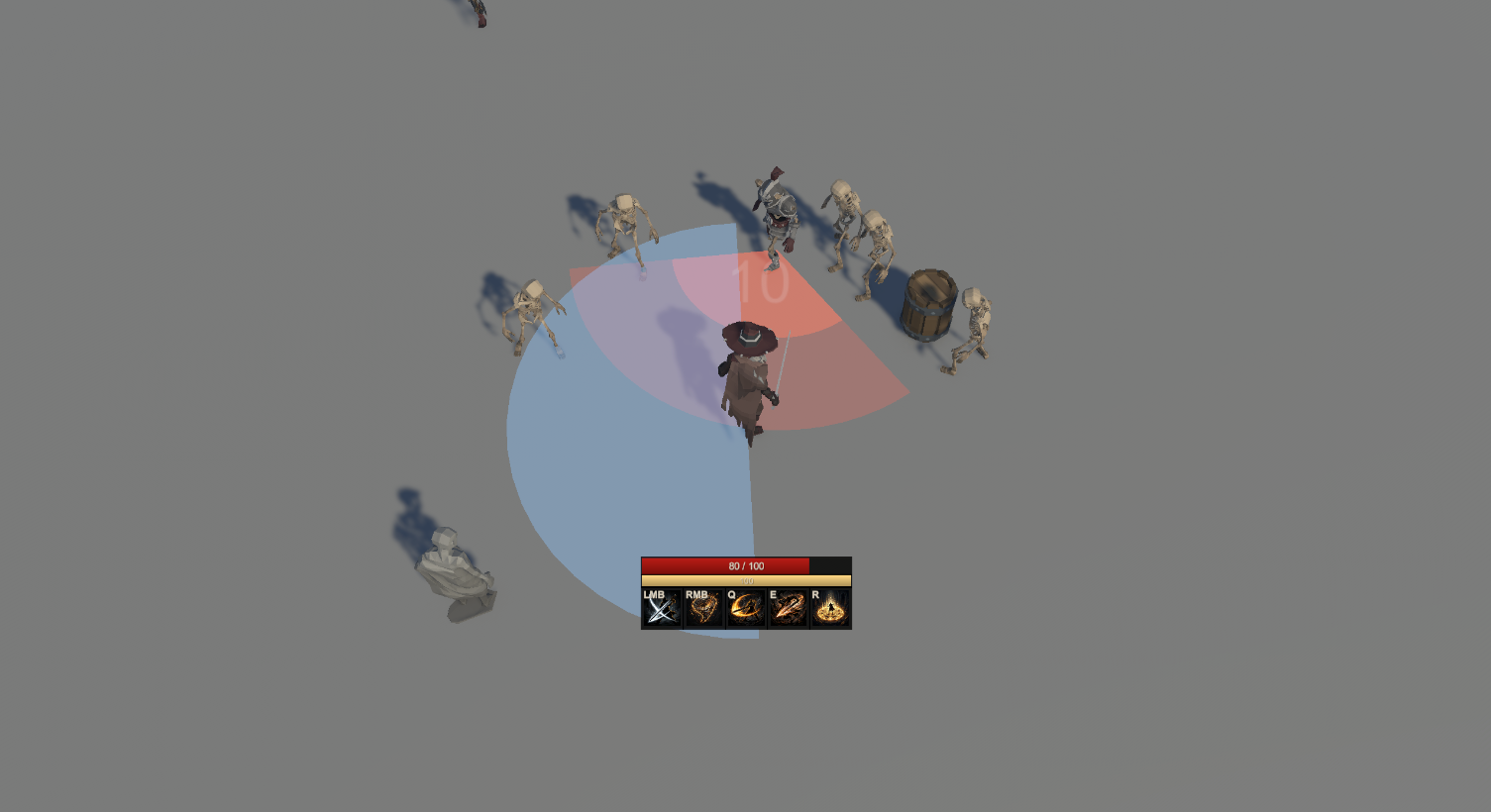
Blue is yours: hold-to-aim telegraphs
The monsters' red telegraphs earned a mirror. Every aimed player ability is now hold-to-aim: holding the button paints a blue preview of the exact hit area — Cleave's 180° cone, Lunge's dash corridor with its arrival strike, Consecrated Ground's placement disc — live-tracking the cursor, with the cast firing on release. Red = theirs, blue = yours; the preview never lies about reach or range, because it's drawn from the same numbers the damage uses. Generators stay instant (holding the attack button now just auto-chains swings), and a spender click interrupts the spam cleanly, handing back to it when done.
Cleave also got its payoff visual: a white-hot energy crescent that sweeps the real arc in sync with the damage frames, leaving a brief amber afterimage — the blue preview states the intent, the amber sweep answers with the result.
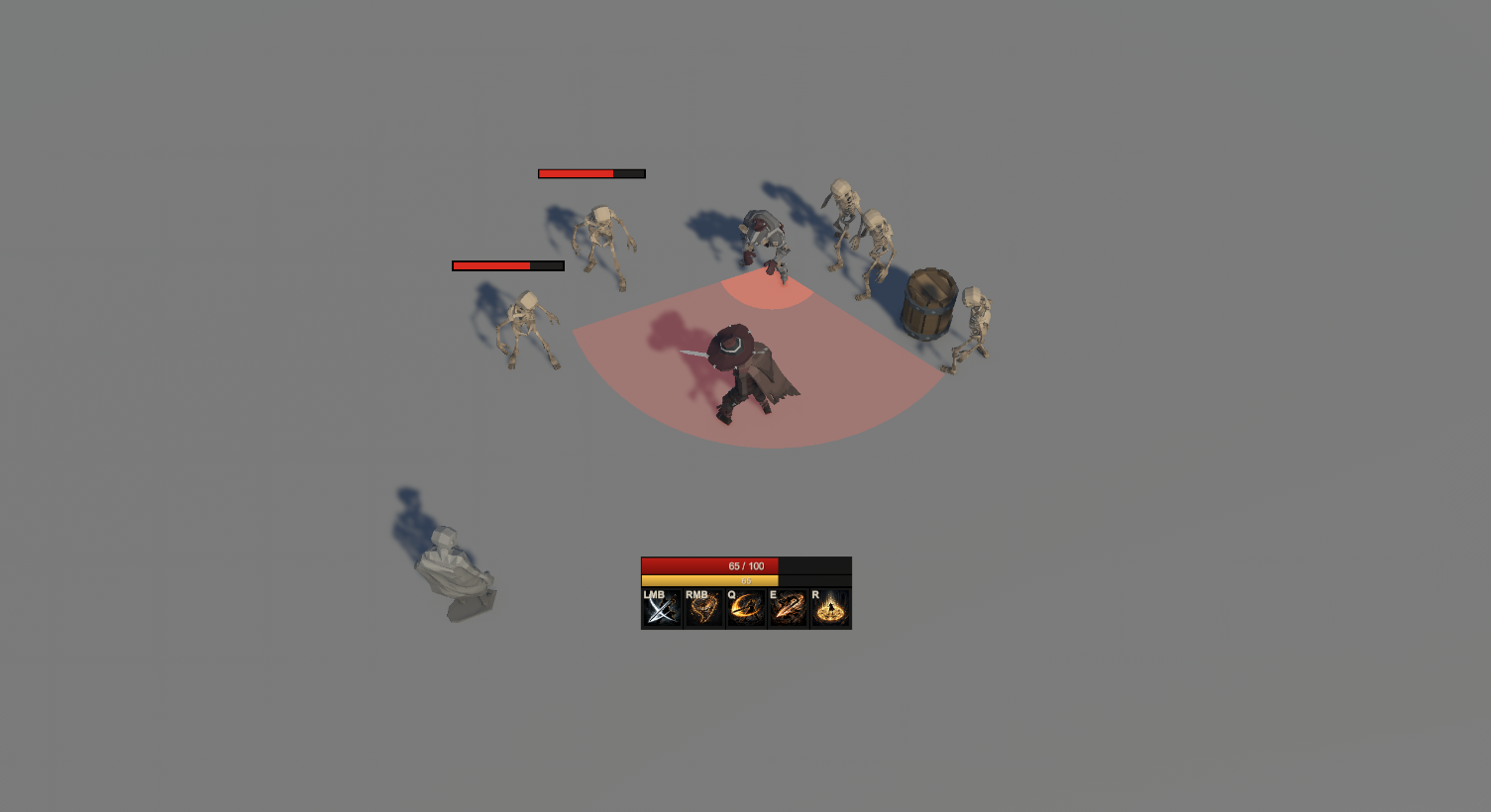
The answer to the blue promise: the swept arc flashing amber as the blow lands. It took one round of eyes-on feedback to get right: faster than the padded damage window, clamped inside the promised cone, following the weapon's actual direction, and ending on a flash instead of a polite fade.
The archer learns archery
The ranger's behavior deepened — plant, aim, loose, stroll, repeat — and its body finally caught up: a full aimed-weapon animation set (aiming idle, firing, weapon-carry walks and runs) so the draw reads on the skeleton itself, not just in the red line. Chasing one down now gets you shot point-blank by something that visibly stood its ground to do it.
Human play is data now
Every botless play session auto-logs: player position, health, resources and speed on a half-second grid, every enemy's position and state, every attack outcome on both sides — including whether a roll's i-frames are what saved you, and where every arrow ended up. The same analyzer that grades bot runs grades human ones. The designer's own sessions are now the reference data the bot will be tuned against: the goal isn't a bot that plays perfectly — it's one that plays like a person.
The cleave's sweep raised one more problem worth its own paragraph: a one-meter sword sweeping a three-meter arc looked wrong. The fix is a trick as old as the genre — the weapon itself grows through the wind-up, sweeps enlarged in sync with the crescent, and snaps back after. And Lunge got its identity the same evening: steel-blue afterimages frozen along the dash path (you were never really there), with the arrival strike landing as its own amber cut. Every one of these effects reads from the same range numbers as the damage, so future +range gear scales the promise, the blade, and the hit zone together — they can never disagree.
Also today, in passing: scroll-wheel camera zoom, green healing numbers, a starter-tier weapon swap with per-weapon grip tuning, heals that scale harder than the damage on the healing circle, and one dead bot — killed by its own new cleave logic marching it through a crowd at 28 health, and revived one fix later. The log caught it. The log catches everything.